
Quick Answer
- Measure at floor level, not halfway up the wall.
- Always measure the narrowest point.
- Check for skirting boards, newel posts, bannisters and uneven walls.
- Compare your measurement with the gate’s stated fitting range, including any extensions.
If you want a stair gate to fit properly, measuring the opening correctly is the most important step. In most UK homes, you should measure the narrowest point at floor level, from wall to wall, skirting to skirting, or post to post, depending on where the gate will be fixed.
This guide explains how to measure for a stair gate, what to check at the top and bottom of the stairs, when you may need extensions, and how your measurements affect whether a pressure fit or screw fit stair gate is the better option.
In this guide
What you need before you start
- A tape measure
- A pen or your phone to note measurements
- The exact place where the gate will be installed
- If possible, the product fitting range for the stair gate you are considering
How to measure for a stair gate step by step
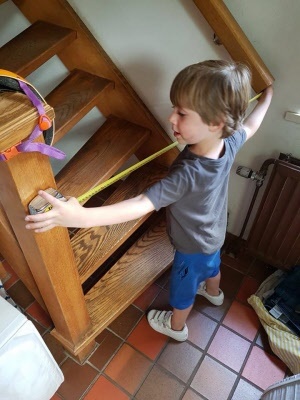
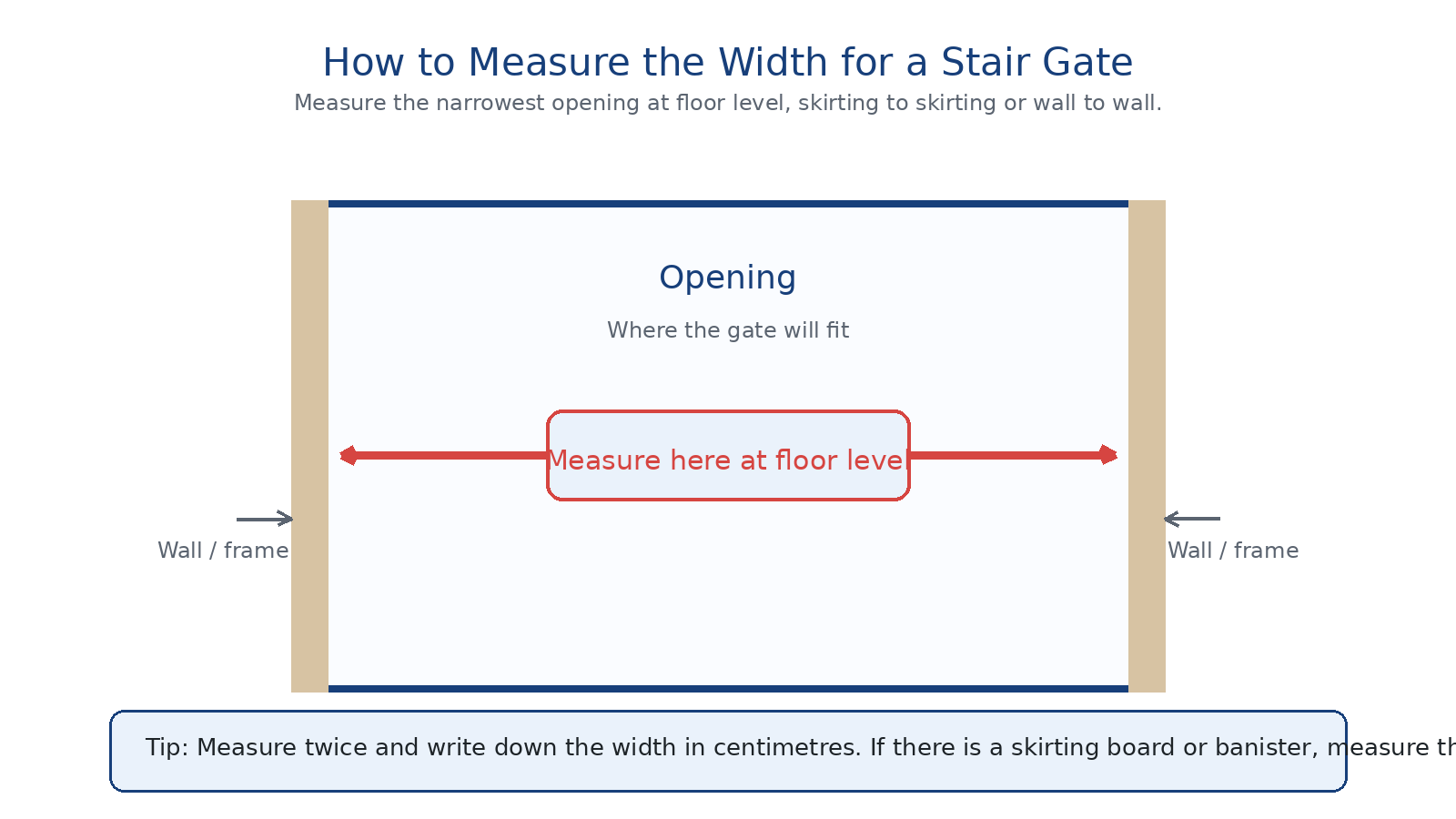
Measure the opening at floor level
Measure from one side of the opening to the other at the point where the stair gate will sit. In some homes this will be wall to wall. In others it will be skirting board to skirting board or post to post.
Do not measure higher up unless the manufacturer specifically tells you to. The floor-level measurement is usually the one that matters when choosing the correct size and any extensions.
Check the narrowest point
Older UK houses are rarely perfectly square. Skirting boards, uneven plaster, or slightly angled walls can make one part of the opening narrower than another. Measure in at least two or three places and work from the smallest number.
Note any obstacles or fixing points
Look carefully at what the gate will fix to. A stair gate may be mounted against a solid wall, a newel post, a bannister, or a combination of these. That affects both the measurement and the type of gate that is suitable.
- Skirting boards can reduce usable space.
- Round bannisters may need special fittings.
- Uneven surfaces can affect how neatly a pressure fit gate sits.
- At the top of stairs, the exact fixing position matters for safety.
Compare the width with the gate’s fitting range
Every stair gate has a stated fitting width, for example 75 to 82 cm, or a base size plus extension pieces. Once you know your opening width, compare it with the gate’s actual fitting range, not just the product name.
If your opening is wider than the base gate, you may need one or more stair gate extensions. If it is only just inside the range, double-check your measurement before ordering.
Measure again before you buy
It sounds obvious, but this is where many people go wrong. Measure twice, write the result down, and only then choose the gate. A stair gate that is a few centimetres out can create unnecessary returns, delays, and fitting issues.
How to measure at the top of stairs
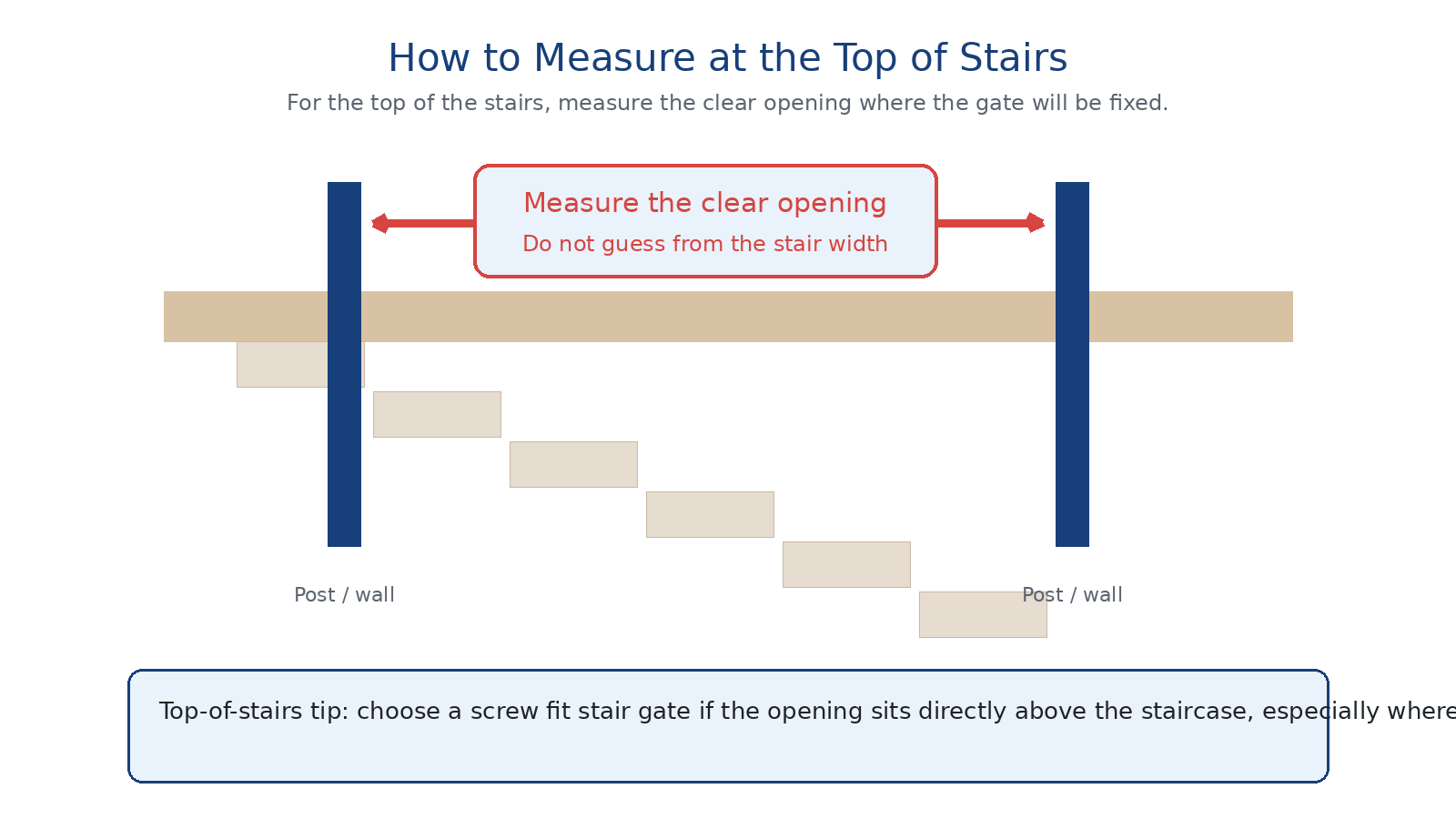
The top of the stairs is the most safety-critical position. Measure the clear opening where the gate will be fixed, not the full width of the landing or the staircase itself.
In many cases, a screw fit stair gate is the safer choice at the top of stairs, especially where there is no flat threshold area or where a trip bar would create a hazard. If you are unsure, read our guide to pressure fit vs screw fit stair gates.
How to measure at the bottom of stairs
At the bottom of the stairs, the measuring method is similar: measure the opening at floor level and work from the narrowest point. In many homes, a pressure fit stair gate can work well here, provided the surfaces are suitable and the fitting range matches your measurement.
Common stair gate measuring mistakes
- Measuring too high instead of at floor level
- Ignoring skirting boards or trim
- Measuring the staircase rather than the actual fixing point
- Forgetting to allow for extensions
- Assuming all 75 to 82 cm gates fit the same way
- Ordering before double-checking the smallest measurement
Do you need stair gate extensions?
If the opening is wider than a standard gate, you may need extensions. Always check whether the gate brand supports the extension size you need, and whether multiple extensions can be used together. The exact combination matters more than the headline product width.
After measuring, which type of stair gate should you choose?
Once you know the opening width and the fixing surfaces, it becomes much easier to choose the right model. If you are still deciding, start with our full stair gates collection, then compare your options with these related guides:
- Pressure fit vs screw fit stair gates
- Best stair gates for top of stairs
- Stair gate safety rules in the UK
Ready to find the right stair gate?
Browse our full range and find a gate that fits your exact opening size.
Shop Stair GatesFrequently asked questions
Do I measure a stair gate opening in centimetres?
Yes. Most stair gate fitting ranges in the UK are shown in centimetres, so measuring in cm makes it easier to compare your opening with the manufacturer’s stated range.
Do I measure wall to wall or skirting to skirting?
Measure the actual usable opening where the gate will fit. If the skirting boards protrude into the fitting area, the relevant measurement is often skirting to skirting rather than full wall to wall.
Can I use a pressure fit stair gate at the top of stairs?
Sometimes, but not always. At the top of stairs, a screw fit gate is often the safer option because it avoids a threshold bar and gives a more secure fixed position. Always check the manufacturer’s guidance and your fixing surface.
What if my opening is wider than a standard stair gate?
You may need extension pieces or a wider gate model. Check the exact extension combinations supported by the brand before ordering.
What is the best way to avoid ordering the wrong size?
Measure twice, use the narrowest point, and compare that result with the product’s stated fitting range, including extensions. If the opening is at the top of stairs, also think about the safest fixing method, not just the width.
If you want help choosing the right size after measuring, browse our stair gates or contact us for advice.